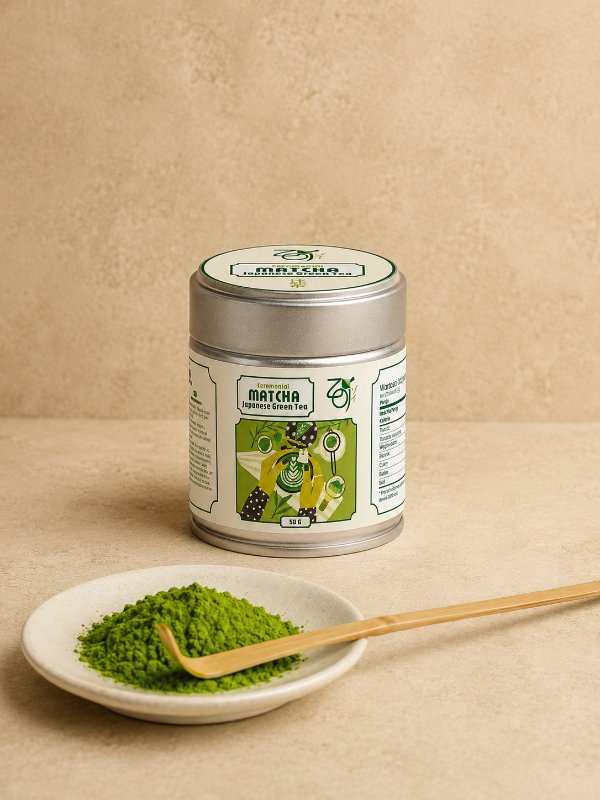
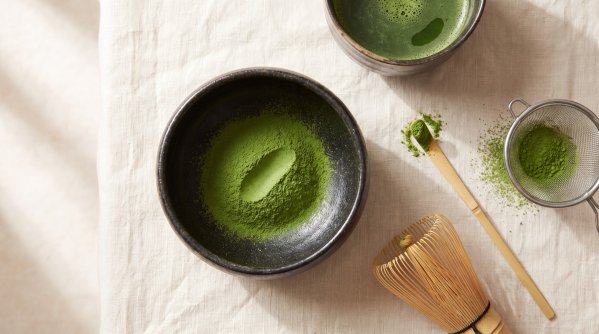
Matcha consists of whole green tea leaves ground into a powder — you drink them, rather than brewing them and throwing them away. That’s why a single cup contains more caffeine, L-theanine and catechins than an infusion made from the same amount of leaves. It holds a little less caffeine than an espresso. Side effects arise in the same way as with any caffeine: when consumed in excess — and when drunk with a meal.
What’s in a single cup
A standard serving is 2 g of powder. It contains roughly 60–70 mg of caffeine, L-theanine, catechins (including EGCG) and chlorophyll, to which matcha owes its colour. Because you’re consuming the leaf itself, rather than just what’s released into the water, all these compounds end up in your cup in their entirety.
Shading is responsible for its distinctive flavour profile: the bushes are covered for a few weeks before harvest. The leaf defends itself against the lack of light by producing more chlorophyll and amino acids — hence the intense green colour, umami and natural sweetness rather than mere astringency. We’ve outlined the differences between the types in a separate article: ceremonial or culinary.
Caffeine and L-theanine: what is known
L-theanine is an amino acid that shaded leaves contain significantly more of, and matcha is shaded before harvest. The effects attributed to it have not been confirmed: in 2011 the European Food Safety Authority (EFSA) assessed claims about its effect on cognitive function, psychological stress and sleep and found no cause-and-effect relationship. Nor has it been confirmed that L-theanine changes how caffeine acts. So what is known is that it is in the cup.
You count the caffeine in matcha just like any other: it adds up with coffee, tea and energy drinks, and in the evening it acts just like the caffeine in coffee. We’ve put the figures per gram and teaspoon in our article on how much caffeine is in matcha.
In its 2015 opinion, EFSA concluded that for healthy adults, up to 400 mg of caffeine a day and single doses of up to 200 mg raise no safety concerns. Converted, 400 mg is about 11–13 g of matcha, but the figure covers caffeine from all sources, including coffee and energy drinks.
Catechins and EGCG
Catechins are a group of polyphenols found in abundance in green tea; EGCG is the one most often mentioned. The European Union has not authorised any health claim for them: no health benefit has been accepted as proven.
One thing, however, is well-documented and practical. In its 2018 opinion, EFSA noted that EGCG, in doses of 800 mg per day taken as supplements, has been linked to elevated liver enzymes. EFSA does not link traditionally brewed tea to this. Matcha is not an infusion, though: you drink the whole ground leaf, so a cup holds more EGCG than an infusion made from the same amount of leaves, and that conclusion cannot simply be applied to matcha. Agree the number of cups with your doctor.
Side effects worth knowing about
Excess caffeine. Insomnia, heart palpitations, irritability. The caffeine in matcha acts in the evening just as coffee’s does.
On an empty stomach. Some people experience discomfort or nausea. This isn’t always the case, but if you do, drink your matcha after breakfast, not instead of it.
Iron. The polyphenols in tea reduce the absorption of non-haem iron, i.e. that found in plants. If you’re iron-deficient or eat little meat, drink matcha between meals, not with them.
Pregnancy and breastfeeding. In EFSA’s opinion, the figure for pregnant and breastfeeding women is 200 mg of caffeine a day — approximately 6 g of matcha. Discuss your limits with your doctor, not a tea shop’s blog.
Medication. Caffeine and vitamin K from green leaves can interact with, amongst other things, anticoagulants. If you’re on regular medication, ask your doctor.
How much caffeine a day
In EFSA’s opinion, up to 400 mg of caffeine a day from all sources raises no safety concerns for healthy adults; the conversion into grams is given above. Agree the number of cups a day with your doctor. For drinking on its own, opt for ceremonial matcha; for lattes and bakes, culinary matcha works better as it doesn’t get lost in the milk.
If you’re just choosing your first tin, here’s a short guide to help you make your first choice.
Frequently asked questions
Is matcha healthier than ordinary green tea?
It is more concentrated, which isn’t the same as being healthier. As you’re drinking ground leaves, you get more caffeine and catechins in a single serving than you would from an infusion. No health claim for catechins is authorised in the EU, so there is no basis for calling matcha healthier. More caffeine per serving does mean you reach your daily total sooner.
Can matcha be harmful to the liver?
EFSA’s 2018 opinion linked raised liver enzymes to EGCG taken as supplements at 800 mg a day or more, not to traditionally brewed tea. Matcha is not an infusion, though: you drink the whole leaf, so that conclusion cannot simply be applied to it. What this means for you is a question for your doctor, not the shop.
Is drinking matcha on an empty stomach a bad idea?
For some people, yes — it can cause stomach discomfort. If this applies to you, simply have your cup after breakfast.
Does matcha leach iron?
It doesn’t leach iron, but it does reduce the absorption of plant-based iron if you drink it with a meal. This matters mainly in cases of iron deficiency or a meat-free diet: then drink it between meals, not with them.
Can you drink matcha every day?
What counts is your total daily caffeine from all sources: in EFSA’s opinion, up to 400 mg raises no safety concerns for healthy adults, and a 2 g serving of matcha has about 60–70 mg. Agree the number of cups with your doctor. The time of day is a separate issue: a late cup of matcha can make it harder to fall asleep, just as a late cup of coffee can.
Is matcha safe during pregnancy?
For caffeine in pregnancy the figure is significantly lower: in EFSA’s opinion, 200 mg a day from all sources, which is roughly 6 g of matcha. This is a question for your GP, not the shop.