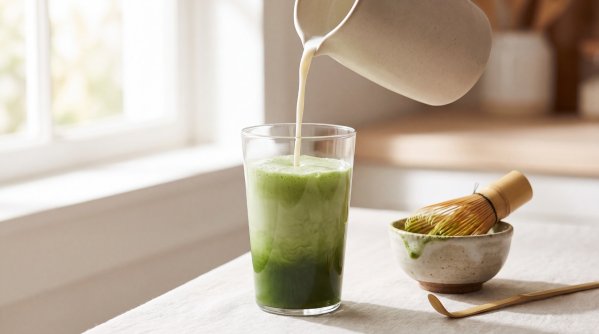
The lumps are caused by a single mistake: the powder goes straight into the milk. Matcha dissolves in water, not in fat — it clumps up immediately in milk, and no amount of stirring will break it up. The secret lies in the order: 2–3 g of matcha, 50–60 ml of hot water, whisk until smooth, and only then add the milk.
Why does matcha clump together?
Matcha isn’t soluble. It’s a very finely ground leaf that you suspend in water — not sugar, which dissolves. The particles tend to clump together, especially if the powder has been sitting in a damp cupboard. In milk, which is thicker and creamier than water, these clumps remain intact and stick to your tongue.
Hence two habits that sort out the problem once and for all: sifting the powder and whisking it first in a small amount of water.
Step-by-step guide
Sift 2–3 g of matcha through a sieve into a wide bowl or mug. It takes just five seconds, but it makes all the difference.
Pour in 50–60 ml of water at a temperature of 75–80 °C.
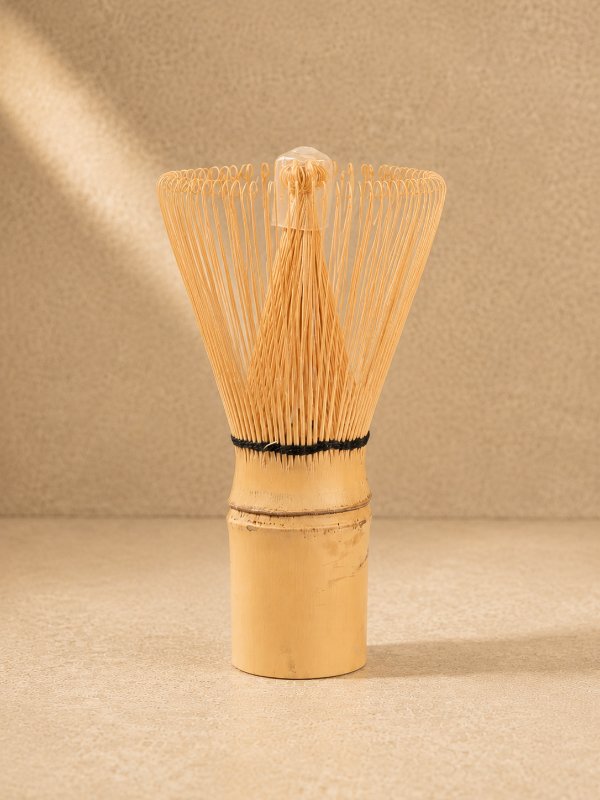
Whisk with a chasen in a ‘W’ motion, starting from the wrist, for 15–20 seconds — until all lumps have disappeared and a fine foam appears.
Heat 180–200 ml of milk to 60–65 °C and froth it.
Pour the milk in a thin stream down the side of the glass into the whisked matcha, then spoon the foam on top.
You can find the complete recipe with measurements here: hot matcha latte.
How much matcha for one latte
Two grams is a subtle amount, three is a distinct one. For a latte, it’s best to aim for three: the milk and any syrup will mask some of the flavour, so two grams of matcha might disappear completely. A chashaku teaspoon measures roughly one gram, which is two or three scoops per cup.
Water temperature matters
Boiling water brings out the bitterness in the leaves and denatures the delicate amino acids responsible for the sweetness. Aim for 75–80 °C. If you don’t have a thermometer: bring the water to the boil and leave it to stand for two to three minutes, or add about one-fifth cold water to the boiling water.
What to use to whisk if you don’t have a chasen
A bamboo whisk has several dozen thin rods and therefore breaks up clumps that nothing else can – the chasen is the cheapest item in the set that really makes a difference. Without it, there are two alternatives:
An electric frother. It works well, although the foam is coarser and less creamy than that produced by a chasen.
A jar with a screw-top lid. Add matcha and water, screw the lid on, and shake for half a minute. It’s a makeshift method, but an effective one — and the only one you can do at work.
A whisk and a fork aren’t enough: they’re too thick to get between the particles.
Which milk foams best
‘Barista-style’ oat milk foams best and has a natural sweetness, so you often don’t need to add any sugar. Soya milk produces a thick foam, but if the matcha is too acidic or the temperature is too high, it can curdle. Almond milk is the least common and foams the least. Cow’s milk works perfectly well — full-fat is better than skimmed.
Whatever you choose, don’t bring it to the boil. Overheated plant-based milk loses its sweetness, and the foam collapses within a dozen or so seconds.
Ceremonial or culinary matcha for a latte
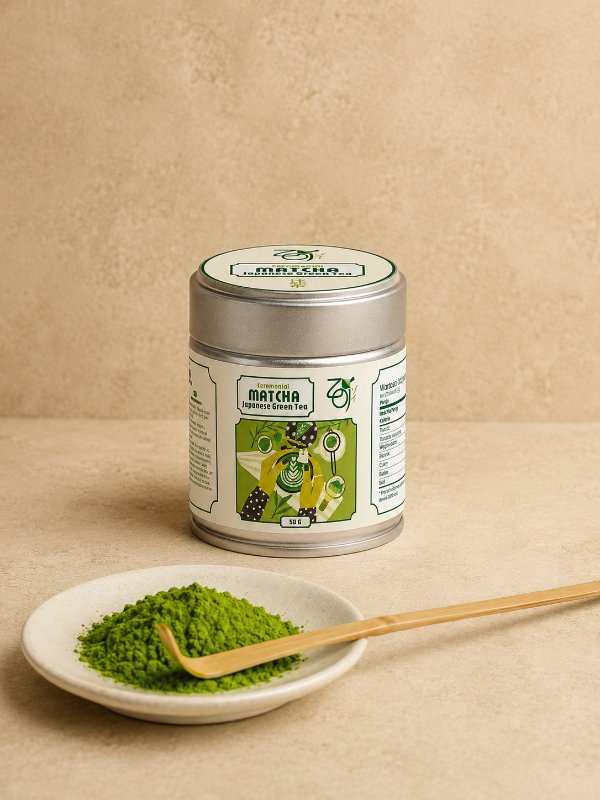
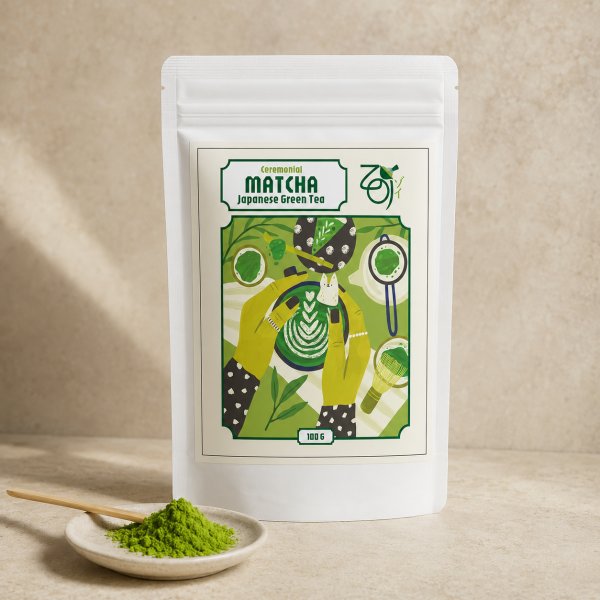
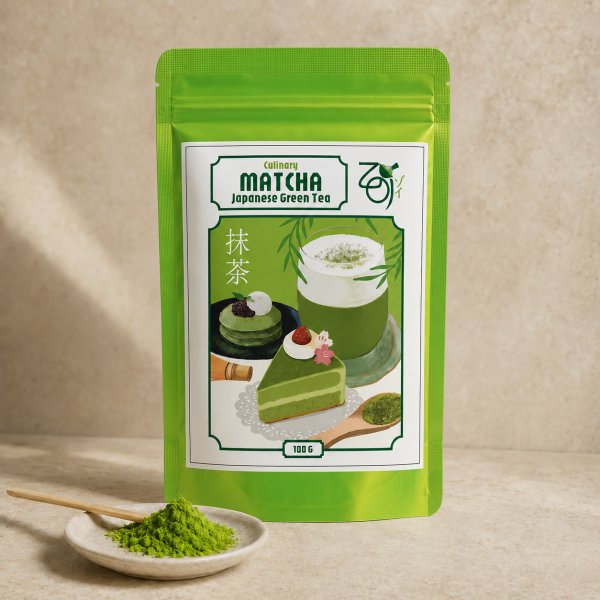
Cooking-grade matcha is better for lattes. It has a stronger, more distinctive flavour profile that cuts through the milk, and it costs less — and you won’t be able to detect the subtleties of ceremonial-grade matcha beneath the frothed milk anyway. Save the ceremonial-grade matcha for drinking with plain water. One hundred grams of culinary matcha is enough for about forty lattes, so one tin lasts roughly a month of daily drinking.
If you’re not sure which matcha you have in your cupboard and what it’s suitable for, this article on the difference between ceremonial and culinary matcha will help you decide.
Frequently asked questions
Why is my matcha latte bitter?
Most often, it’s because the water is too hot. Boiling water extracts tannins and bitterness from the leaves — lower the temperature to 75–80 °C. The second reason is too much powder to too little water, and the third is old matcha that has turned brown in an open tin.
Can you make a matcha latte without a chasen?
Yes, you can. An electric frother works well, and in a pinch, a sealed jar and half a minute of shaking will do. A chasen gives the smoothest result, but it isn’t essential for success.
What’s the right water temperature for matcha?
75–80 °C. If you don’t have a thermometer: bring the water to the boil and wait two to three minutes. Boiling water will always produce a bitter brew, regardless of the quality of the powder.
How much matcha for one latte?
Three grams, or two to three chashaku scoops. Two grams are enough for a smaller cup or if you prefer a milder flavour.
Can you make a matcha latte cold?
Yes, but you still need to dissolve the powder in warm water first – you won’t be able to dissolve it in cold milk at all. The whisked matcha is then poured over ice and cold milk. We’ve described this step by step in our recipe for a cold matcha latte.
Why does plant-based milk curdle?
Usually because of the temperature or acidity. Don’t heat it above 65 °C and don’t pour hot matcha into cold soya milk — bring the temperatures to the same level first. ‘Barista’ versions are stabilised specifically with this in mind.