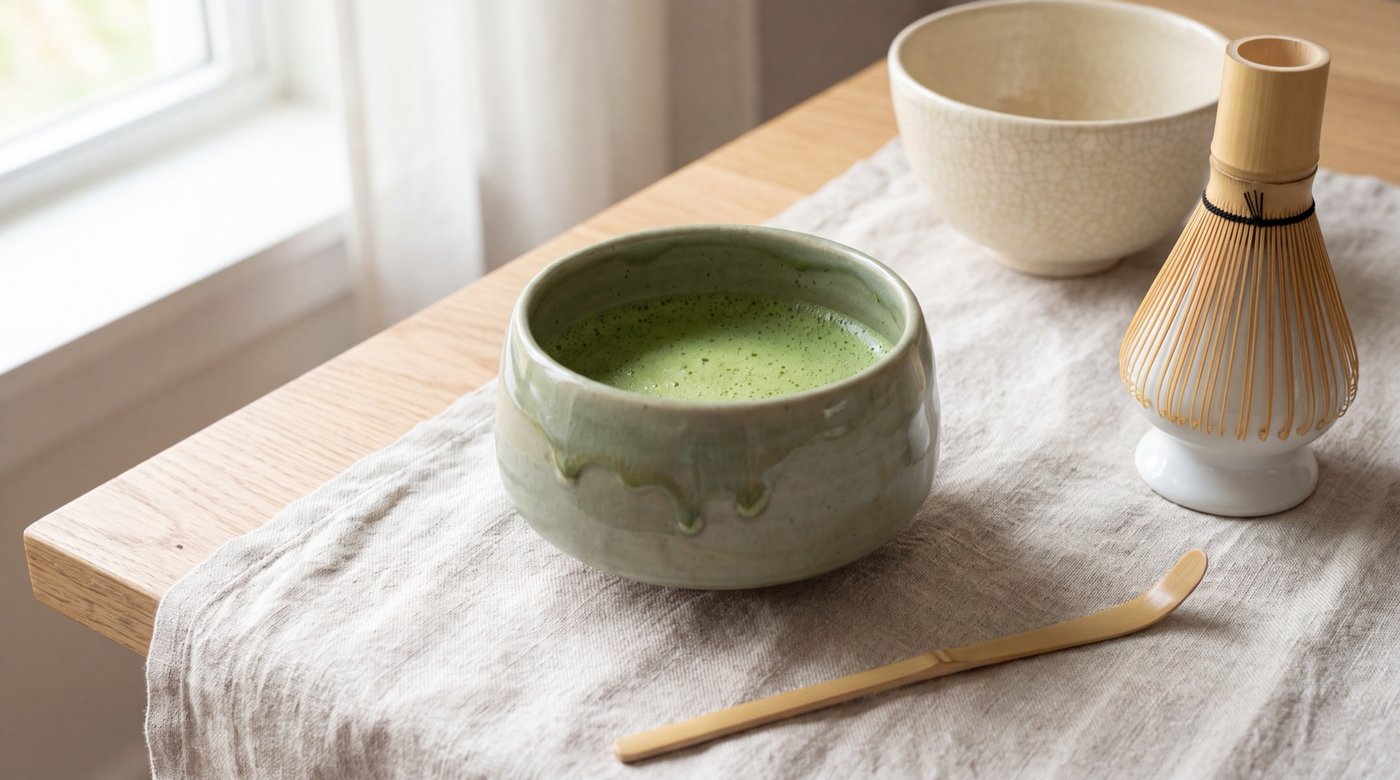
A good matcha bowl is about 12 cm across and 7–8 cm high, with a wide, flat bottom. That's the room a chasen needs to whisk up a foam with a W-shaped motion. A capacity of 300–400 ml is plenty: for usucha you only pour in 60–70 ml of water, and the spare room keeps splashes off the worktop and leaves space for milk if you're making a small latte.
How a matcha bowl differs from a mug or an ordinary bowl
Chawan literally means “tea bowl”. What sets it apart from a mug or an everyday bowl is mainly the bottom. In a narrow mug, the chasen has no room for the W-shaped motion and the tines knock against the sides. In a narrow, deep bowl, such as a rice bowl, the bottom is small and steeply rounded, so the whisk only works at the lowest point and stirs instead of whisking.
A matcha bowl has a wide bottom and walls thick enough that you can hold it while the matcha is still hot. Underneath is a foot ring that lifts it off the table and gives your fingers a comfortable place to rest.
Size and capacity
A typical matcha bowl is 11–13 cm across and holds 300–400 ml. That's a lot for 60–70 ml of water, but whisking needs space: in a small vessel the matcha splashes over the rim with every quick stroke. Bowls narrower than 10 cm look lovely on a shelf, but they're too cramped for usucha.
The extra room helps with lattes too. In a 350 ml bowl like the one in the Zen set (about 7.5 cm high and 12 cm across), you can whisk the matcha and add enough milk for a small latte (about 150 ml) without transferring it to a mug.
Shape: flat, classic or tall
In the tea ceremony, the shape of the bowl is also matched to the season. For everyday use, though, what matters most is how comfortable it is to whisk in.
- Flat and wide (hira-chawan). The traditional summer bowl: the matcha spreads out in a thin layer and cools faster. With 60–70 ml of water the whisk easily scrapes the bottom, so it can be awkward for daily use.
- Classic, with rounded sides and a broad bottom. For the whole year, and the best first bowl. It's forgiving of an unpractised hand and suits both usucha and lattes.
- Tall and narrow (tsutsu-chawan). The traditional winter bowl: it holds heat longer, but the smaller diameter makes whisking harder.
- With a spout. Lets you pour the whisked matcha into a glass of milk in one movement, without drips on the worktop. Handy if you mostly drink lattes.
Bottom, walls and glaze
- A smooth interior. The chasen glides over a smooth bottom without resistance, and no powder gets caught in rough patches. A small hollow in the middle of the bottom is traditional and does no harm — the last sip collects there.
- Thicker walls. They hold heat longer and don't burn your hands.
- The glaze. A smooth glaze is easy to rinse and doesn't change colour. A crackle glaze darkens over time as tea seeps into the fine cracks. Many people value that as a sign of use, but if you'd rather the colour stayed the same, choose a smooth one.
- Hand glazing. Hand-glazed bowls differ in shade and in how the colours blend. That's a feature of the technique, not a flaw.
Warm the bowl before you whisk
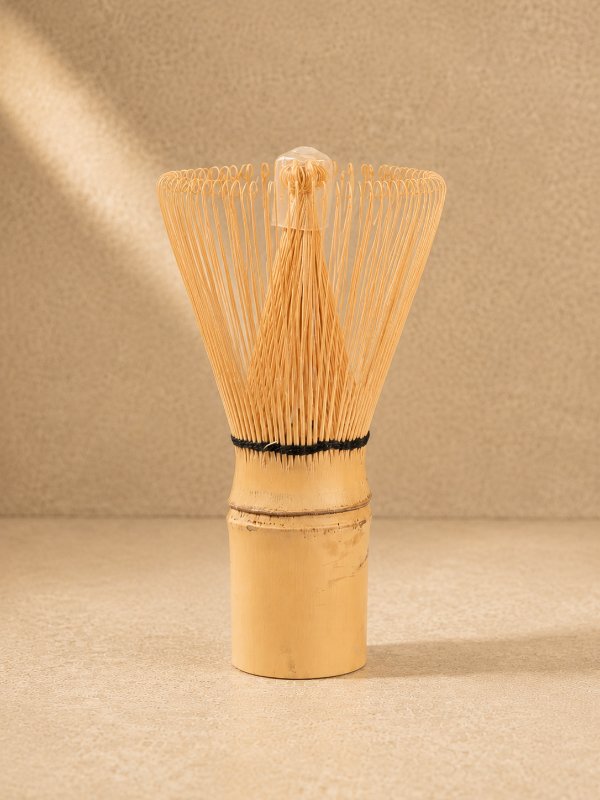
Cold ceramic draws heat out of water quickly, and 60–70 ml doesn't have much to spare. So before whisking, pour hot water into the bowl and dip the tips of the chasen in it for a minute — the bowl warms up and the tines soften so they don't break. Then pour the water away and wipe the bowl dry, because the powder clumps on drops of water. Our traditional usucha starts with this step.
Washing and storage
If you rinse the bowl straight after drinking, warm water alone is enough to get matcha off a smooth glaze. You don't need washing-up liquid; if you do use it, rinse the bowl thoroughly so the smell doesn't carry over to the next serving. Hand-glazed ceramics are better kept out of the dishwasher: hot water and strong detergent can dull the glaze over time, and in a crowded rack the rim chips easily.
The bowl must be completely dry before you put it away. Don't leave a wet chasen in it — how to dry the whisk so it doesn't go mouldy is covered in our guide on how to choose a chasen.
What to use instead of a matcha bowl
You don't need a special vessel to start. Any flat-bottomed bowl at least 11 cm across will do, such as a flat-bottomed soup bowl. A narrow mug or a glass won't. A matcha bowl makes whisking easier and holds heat longer, but you can make good matcha without one.
If you're putting your kit together from scratch, take a look at our sets: some of them already pair the bowl with a chasen, a chashaku and a whisk holder, so all you need to add is the tea.
Frequently asked questions
Do you need a special bowl for matcha?
Not necessarily. A flat-bottomed bowl at least 11 cm across, where the chasen has room for a W-shaped motion, is enough. A narrow mug won't work — the tines knock against its sides.
What size matcha bowl is best?
The most versatile is a bowl of 300–400 ml, about 12 cm across. For usucha you only pour in 60–70 ml of water, but the extra room prevents splashing while you whisk and lets you add milk for a small latte.
Can a matcha bowl go in the dishwasher?
Better not, especially if it's hand-glazed. Hot water and strong detergent can dull the glaze over time. Rinsing the bowl with warm water straight after drinking is enough.
Why warm the bowl before whisking?
Cold ceramic quickly cools the small amount of water you use for usucha. A warmed bowl keeps the matcha warm, and you can soak the chasen in the same water.
What is a matcha bowl with a spout for?
For pouring. You whisk the matcha in the bowl, then pour it into a glass of milk in one movement, without drips on the worktop. It's most useful if you mostly drink lattes.
Why is the inside of my matcha bowl getting darker?
Usually it's a crackle glaze: tea seeps into the fine cracks and darkens them over time. That's natural, not a flaw. A smooth glaze keeps its colour if you rinse the bowl straight after drinking.