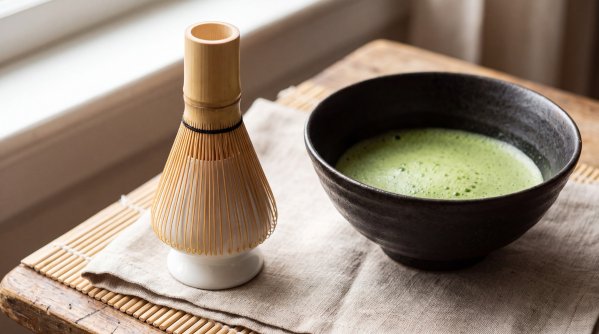
For everyday matcha, a chasen with 70–80 tines, carved from a single piece of bamboo with no glue or lacquer, is all you need. If you mostly drink usucha, a chasen with 100–120 thinner tines is better, and for thick koicha, one with fewer, thicker tines. How long it lasts then comes down to care: soaking before use, rinsing with plain water and drying in the air.
Why a chasen at all
Matcha is a powder that doesn't dissolve in water — it forms a suspension. A spoon leaves lumps, and an electric frother breaks up the powder but makes a foam of big bubbles that collapses quickly. A chasen works differently: dozens of thin tines cut through the water at once and break the air into tiny bubbles. That's where the dense, velvety foam comes from — it sits on the surface and softens the taste.
For a latte, a frother will do. For matcha with water alone, a chasen is the one tool you can't sensibly replace.
80, 100 or 120 tines
The number of tines mainly tells you how thin they are. From bamboo of the same diameter, more tines means thinner, springier ones; fewer means thicker, stiffer ones.
- 100–120 tines. The finest foam. A good choice if you mostly drink usucha, the classic frothy matcha made with water.
- 70–80 tines. The most versatile choice. A chasen like this handles usucha, lattes and dessert bases, and its thicker tines break less often.
- Fewer, thicker tines. For koicha, a thick matcha that isn't whisked but slowly kneaded. Thin tines would break in such a dense paste.
The number alone doesn't decide quality, though. What matters more is how the whisk is made.
How to spot a good whisk
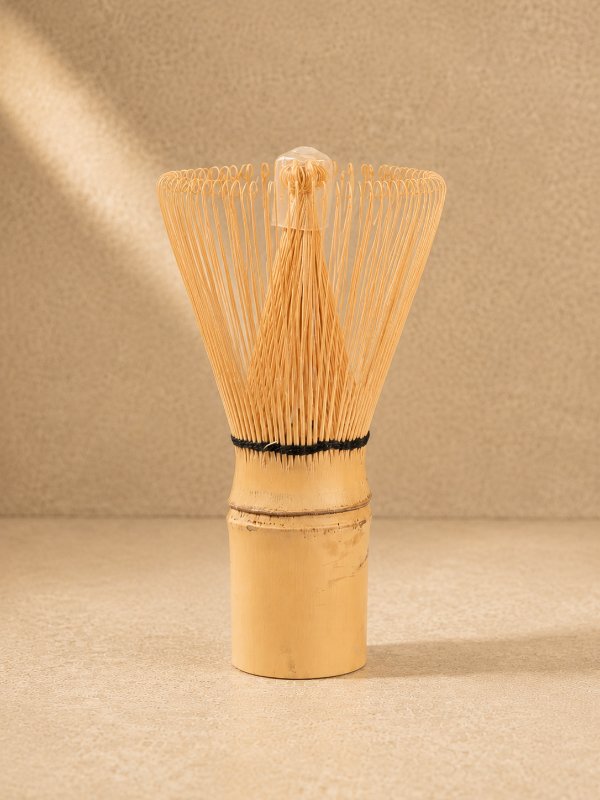
- One piece of bamboo. The handle runs into the tines with no gluing or joins.
- Even, thin tines. Spread symmetrically, with no cracks or stuck-together strands, and tips curled slightly inwards.
- Two circles. The outer tines form a wide circle, and some are bent inwards to form a smaller, inner one.
- A thread at the base. It weaves between the tines and keeps them evenly spaced. Without it, the tines soon splay apart.
- No lacquer, no chemical smell. A chasen works in hot water, so it should smell of bamboo and nothing else.
Before first use
A new chasen is dry and stiff, and dry tines crack easily. Dip the head in lukewarm water for a minute until the tines soften. They may open out slightly — that's normal. After that, before each use, stand the head in hot water poured into your bowl for a minute — it warms the bowl at the same time.
How to whisk without breaking tines
When whisking usucha, the movement comes from the wrist, not the whole arm. Move quickly in a W shape just above the bottom of the bowl, but don't press the whisk down. The tines may at most brush the bottom, not scrub it. After 15–20 seconds, slow down, skim the whisk across the surface to break the largest bubbles, and lift it out from the centre.
The bowl matters too. A narrow mug has no room for a W-shaped motion, and the tines knock against its sides. A wide matcha bowl with a flat bottom gives the whisk room to work.
Cleaning and drying
- Straight after use. Rinse the head by moving it through clean, warm water in the bowl until the water no longer turns green.
- No washing-up liquid, no dishwasher. Detergent stays in the tines and spoils the taste, and high heat splits the bamboo.
- Air-dry it. Ideally on a ceramic whisk holder, placed head down — the holder keeps the tines in shape, and water drains away from their base. Without a holder, stand the chasen on its handle, tines up.
- Never put it away wet. A damp chasen shut in a box can go mouldy within a few days.
When to replace it
A chasen wears out. With daily use and good care it usually lasts from a few months to a year. Replace it when tines break off in whole strands, lose their shape for good, or a dark, fuzzy growth appears at their base. That's usually mould, and a whisk like that isn't worth saving.
A chasen doesn't have to be expensive to work well — it just has to be made from one piece of bamboo and looked after. If you're still putting your kit together, the bamboo set also includes a chashaku for measuring servings.
Frequently asked questions
Do you need a chasen for matcha?
For matcha with water alone, practically yes — it's the only way to get a dense, fine foam without lumps. For a latte, an electric frother or a sealed jar is enough, although the foam will be less dense and collapse sooner.
How many tines should a chasen have?
For everyday use, a chasen with 70–80 tines is the most versatile. If you mostly drink usucha, go for a chasen with 100–120 thinner tines. For koicha, whisks with fewer, thicker tines work better.
How long does a chasen last?
With daily use, usually from a few months to a year. What shortens its life most is drying it in a closed cupboard, washing it with detergent and pressing the tines hard against the bottom of the bowl when whisking usucha.
Can you put a chasen in the dishwasher?
No. High heat and long soaking split the bamboo, and detergent stays in the tines. Rinsing it in warm water straight after use is all it needs.
Why do chasen tines open out?
Soaked tines soften and open out slightly — that's normal. But if they lose their curl week by week, dry the whisk on a holder that keeps its shape.
What do dark spots on a chasen mean?
A dark, fuzzy growth at the base of the tines is most often mould — a whisk like that needs replacing. Bamboo darkening evenly after months of use is normal. To prevent mould, never put your chasen away wet, and let it dry in the air.